Showing posts with label eggs. Show all posts

Tuesday, 2 March 2010

Spring is in the air


It's official. After the dreadful storm last week (all the hives lost their roofs which were found floating in the moat - the bees were unharmed) the sun has come out. This has happened before but today it's different. Let me explain.

On the face of it, despite the blue sky, it is still very cold. The temperature this morning when I woke up was a meagre 3 degrees. Not exactly T-shirt weather. But the day warmed up and this afternoon when I walked the dogs I found I was being buzzed - as I walked through the field about 20 metres from the hives a continuous stream of bees were whizzing past my head and not all of them bothered to detour around me I might add!


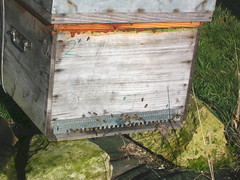
Curious, I took a look at the hives and sure enough the entrances were all frantically busy with bees rushing in and out; most exciting of all was that many of the bees were carrying pollen so there must be some food around somewhere.


Now of course I didn't have my camera with me and by the time the dogs had walked what they considered a reasonable minimum distance and I'd got my camera from the house, it was already a degree cooler and the bees were on their way home. So the photo above shows activity but not the mass excitement of 40 minutes earlier.

It is still not warm enough to give the bees a liquid syrup feed but it is important to keep an eye on the weight of the hives (by hefting them) because this is the time of year when bees starve very quickly. We keep candy on top of the crown boards and it is still being taken down into the body of the hive. I hope that in a few weeks time it will be warm enough for us to open up the hives for their first spring inspection. For me, the first inspection is the beginning of spring and brings so much to look forward to. Of the six hives (including the wild hive) I am hopeful that four have colonies that will survive through to the spring; the other two are touch and go but I haven't given up!

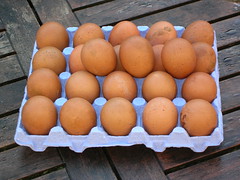
But it wasn't only the bees who were actively showing signs of spring. More good news was to follow. On my way home I collected the eggs and was pleased that once again we had two - although hens lay less eggs during the winter, we have been worried during the past two weeks because we were getting one egg if we were lucky. When Max got home I told him I'd got the eggs and he was astonished - because he had collected two before he went out. And then there were two more this evening from our young hens who are obviously just beginning to come into lay.


Looks like eggs are back on the menu!

Friday, 17 October 2008

Chicken Run

Every morning when I go out to feed the animals the chickens are waiting to be let out of their pen. I usually drop some feed outside the pen so that the five small ones can come out and peck around without being bullied by the bigger ones - most especially the cockerel who really rules the roost with a charging peck. I've given up putting the feed in the feeder on dry days. I just scatter it around for them and they form groups - again, this avoids the cockerel beating them all up!

For the past couple of months we've been a little disappointed that we've only been "given" one egg per day. We are eagerly awaiting the adolescents reaching egg laying age (not long now) but in the meantime we still have the two original hens who should still be laying. Being novices we assumed (hate that word!) that either they were laying every other day or that one of them was no longer laying at all. It never occurred to us to look elsewhere for the reason.

This morning as we were walking back I absent-mindedly kicked a half an egg shell - rather like kicking stones on the path. Two strides later I realised what I had done so Max went on the hunt. Two minutes later he called me over and we found a wonderful pile of eggs - there must have been forty or more but the ones at the bottom of the pile had broken (yuck!) and soaked into the ground leaving 33 still in one piece.

Working on the basis that some of them must still be ok so we gathered up 30 of them and I put them all in a bowl of cold water to see if any of them would float. None of them floated to the top and only one or two looked as if they'd be floating in a day or two. I got rid of the latter, cleaned and dried the rest and then put a pen mark on them so that we use them first and only in things like cakes or omelettes where they are broken first. This way we'll know if I've missed any bad ones.


The chooks were already out of the pen by this time but for the next couple of weeks we're going to leave them in until lunchtime to see if we can get whichever hen it is to start laying inside again. The hen house is inside a large enclosure so they still have plenty of room to run around and to feed so they won't be deprived too much!

Omelette for supper and carrot cake for tea...

Thursday, 7 August 2008

Our chicks have hatched

You may recall from this post earlier in the month that we have had a mixed success with our chickens. The original three, two hens and a cockerel, are alive and well and providing us with two eggs per day. Perfect. In addition, I gave Max an incubator for his birthday and we have had enormous pleasure from hatching chicks from the fertile eggs. Sadly, we lost the second lot of chicks (although they were hardly chicks as they had reached the unattractive six weeks!) to an unseen predator and then we discovered that The Blue Team were all cocks and therefore for the pot. That's the resume in a nutshell!

As some of you know, my formidable mother-in-law (Blind Granny to her blog readers) is, well, blind and we thought it would be a treat for her if we hatched some eggs during her visit here. We duly put seven eggs into the incubator 20 days before she was due to arrive, secure in the knowledge that with a 21 day incubation period the eggs would hatch 24 hours after her arrival. Unfortunately, noone had told the chicks this although in the end it worked out better than we could have hoped!

The first one was born just one hour before Granny and the others (my sister-in-law, her daughter and daughter's friend) arrived. These were followed by two more that evening and one more the following morning. So they had the full on experience you could say. My niece's friend was entranced. She lives in London and has never seen the creation of life at such close quarters. She came running in and out of the kitchen (the incubator is in the playroom next door) to tell us what was going on. It was very touching.


The picture above shows the egg, still in the incubator, with the very first visual sign that the chick is on its way. It has bashed the first, all important, hole in the shell. The rest follows quite slowly but it is very important that you don't give it a helping hand by cracking the shell. During this period you can quite often hear a cheep from inside the egg.


There is nothing remotely attractive about a new-born chick but for me there will always be the awe of the miracle of life. This hideous little thing has been out of its shell for about as long as it took me to find the camera. I'm not quite sure what the piece of string is - nothing to do with the chick at all!

At this point we put some water in the incubator (in a shallow tray with pebbles so that the chick can't drown in it) and leave it alone for a while. It gets itself up and has a drink quite quickly, then flops down again wherever it happens to be (hence the pebbles) and slowly builds up enough strength to find its legs and start moving around. The lid goes back on the incubator in order to keep the heat in - there are more eggs still to hatch and, most importantly, the newly born chick must not get cold. The chick is quite wet when it's born and the warmth helps it dry out and become what we all think of when someone says "new-born chick"...cute and fluffy!

And so our chicks hatched. From seven eggs we hatched five chicks - not bad. The other eggs showed no signs of life and after a further two days in the incubator to be sure we threw them out. The first time this happened we opened the eggs to investigate but I don't do this anymore as it can be upsetting. Just as with humans and other animals, chicks can die in the egg for no obvious reason and it is not a pleasant experience to discover this when you open the egg.


The chicks are now ten days old. Already they are developing a character, interestingly en masse. When I put my hand in to change the water or give them food they all charge towards me at once. At the first sign of a camera they all vanish into a corner. When one lies down and "plays dead" the others stand around it and gaze. The first time I saw this I was really worried but of course s/he got up and they all danced, seemingly in delight at the joke they'd played. When one discovers he can do something, the others all do it as well - have you read John Wyndham's "The Midwitch Cuckoos"? It should have been the Midwitch Chickens, but clearly he'd never seen baby chicks!

They are still in the house although probably not for much longer. At this time of year the playroom warms up just enough for the smell to be over-powering and Eau de Chick is not our favourite to be honest! Also, it is usually warmer outside than in during the day. So we will bring round the chick house that my son made and put them out in the morning and just bring them in at night.

This lot will inevitably become known as the Gang of Five, or the Fab Five perhaps, and in due course we will ring them with a green tag on their legs. This tells us which "batch" they are from and therefore what age they are. OK, we are not exactly running a huge enterprise here with hundreds of chickens running around but it's amazing how fast older chickens start looking like their brothers and sisters. We are hatching chicks for two reasons: eggs and meat. A chicken will start laying eggs at approximately 120 days (depending on the time of year); however, if we need any of the birds for meat, or if we have spare cockerels, we prefer to cull them before this - at approximately 90 days. Hence, we need to know the dates of birth and the different colour rings tell us this.
Wednesday, 23 July 2008

Farewell to the Blue Team

Our first three chicks were hatched from the incubator in late-April and were followed a month later by eight more. They became known as the blue team and the yellow team because of the tags we put on their legs to remind us when they were born, how old they were and when they would mature into egg laying hens. That was the plan.

Unfortunately two weeks ago the yellow team were taken by a fox or other predator - during the day and with no noise, not even disturbing our dogs which is worrying - leaving just a couple of feathers. And yesterday a chicken farmer confirmed my worst fears - the blue team are all cockerels! And so they will be dispatched later today.

This will be a first for us and will no doubt bring us many regrets. However, we have raised these birds with a purpose in mind, knowing full well that if they were not hens we would eat them. They have had a fine time living in the open air and being well looked after. Their diet has been well supplemented by worms and other insects they have found in the garden and it has been a joy to have them following me through the flower beds while I weed. I weed, they feed on the bugs bought to the surface.

We have more eggs due to hatch next week. We timed these ones to hatch when my mother-in-law will be staying. She is blind and we thought this would be a surprise for her as she will be able to hold them before the end of her stay. She follows our life in France very closely (I write that without any of the usual daughter-in-law irony!) and was staying with us when I gave Max the incubator for his birthday. I sincerely hope there will be at least two hens this time - although comments about not counting chickens come to mind! We do still have our original two hens and one cockerel but I find that two eggs a day are not sufficient - especially when our sons start cooking brownies for tea! - and I really resent having to supplement them with shop bought eggs.