Just because I haven't been blogging, don't think I haven't been sorting out the vegetable plot. It's all a bit late this year because of the long winter - can you imagine we are still picking cherries and it's JUNE? Once again we have a good crop - more than we can eat - and the birds are needless to say helping us to eat them. Strawberries have been amazing too. Each day we have picked about 1/2 kilo. Since there are only two of us here during the week guess what? Yum. At the weekend we have to make a huge effort to share them but somehow we manage.
These are the strawberries I planted in the autumn of 2008. Last year we had a good crop. This year we've had an amazing crop. They are in the new vegetable plot (started in 2009) under a plastic sheet to keep the weeds down. I believe that I am meant to replant strawberries every two years so in the autumn I'm going to move them over a bit to where the potatoes are currently growing. This means the ground will be relatively weed free, well manured and in reasonably good nick. The plastic sheet will be reused (it's one of those heavy green ones usually used for hedging) and I'll take runners from the current plants. Hope it works or my name will be mud this time next year!
Monday, 7 June 2010
Saturday, 6 March 2010
Cleaning the Greenhouse
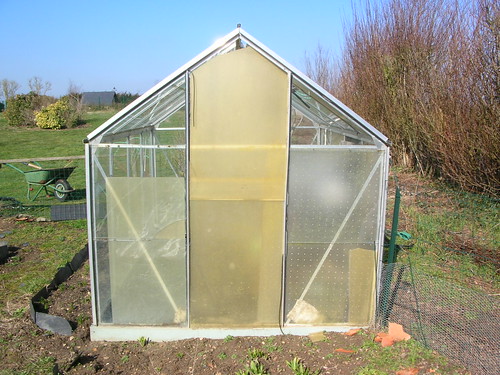
This was the greenhouse this morning. Just to remind you, it was hit by a tornado several years ago and a lot of the glass was broken. We decided then to replace the broken glass with sheets of plastic that we had and for the past five years that has been ok. However, plastic deteriorates with time and sunlight and it has now got to the point where you can't see through it at all. Coupled with the fact that at the back of the greenhouse we "boarded" it up with planks of wood, well, it was time to sort it out.
Oh yes, and the grime...
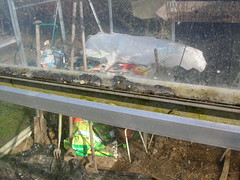

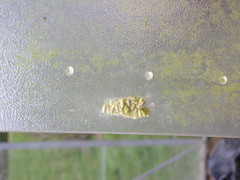
You can see above how the grime collected between the panes of glass (above right where you can also see the black boards at the back) and also, worse, between the glass and the frame (above left - really disgusting!). You don't need to read the books to imagine what is hiding in all that grime - I'm quite sure some of it was moving...look at the cluster of eggs we found hiding between the plastic and the glass:
So we have established that it needed a really good clean! In order to do this properly all the glass had to be removed. Some of you may have heard that there's been a bit of a wind in France recently and playing around with glass is something to be done in calm weather. Today was the day. Not a breathe of wind, lovely sunshine, perfect.
In order to clean the glass I armed myself with a bucket full of the hottest water I could bear, a thick spongey cloth (this is glass remember and the edges are sharp - I have found four cuts on my hand from this job but nothing serious), two towels (for drying the glass - it's slippery and difficult to replace when it's wet), a toothbrush and an old scrubbing brush (the type used for dishes). All were required.
Max had other items - a flat headed screwdriver for removing/replacing the "W" clips and a nice collection of swear words for when the same clips flew out and hit him in the face - several times. (Also, a slightly peeved expression because he'd read my previous post about the greenhouse...)
The grime between the panes of glass was so thick that it took a fair bit of scrubbing - this was the job of the toothbrush. The hot water eventually soaks through the dirt so often I'd come back to one that "I'd prepared earlier". The scrubbing brush and the toothbrush were also used for cleaning the bits of frame normally under the glass - again, dirt had built up where the water runs down in gulleys. Yuck, Yuck, Yuck.
We took it slowly. First the roof glass was removed, cleaned, the frame cleaned, the glass replaced. Then the same process with the side glass.
This is the moment to introduce the hero of the day in action...(drum roll please)...

This really is not a one man job. Apart from anything else those pesky clips kept falling on the ground just when the glass was being held in place. However, we learnt something today - this is a job that is easier than we thought. Yes, it takes time and patience and has to be done calmly but it really was worthwhile.
This is the greenhouse as we left it this evening...
This is the greenhouse as we left it this evening...
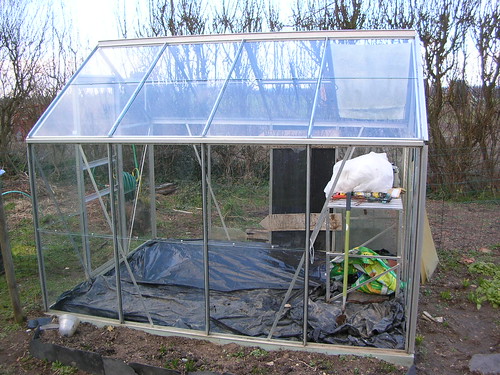
It's not finished yet - you might notice that the front on the right has no glass at all. All in all we need 14 new panes of glass (none of which were broken today) which we will get cut this week. I rather fear that will be the moment we discover it would be cheaper to buy a new greenhouse; I'll let you know!
Tuesday, 2 March 2010
Spring is in the air
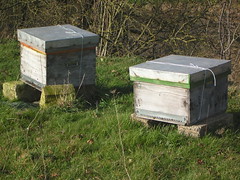
It's official. After the dreadful storm last week (all the hives lost their roofs which were found floating in the moat - the bees were unharmed) the sun has come out. This has happened before but today it's different. Let me explain.
On the face of it, despite the blue sky, it is still very cold. The temperature this morning when I woke up was a meagre 3 degrees. Not exactly T-shirt weather. But the day warmed up and this afternoon when I walked the dogs I found I was being buzzed - as I walked through the field about 20 metres from the hives a continuous stream of bees were whizzing past my head and not all of them bothered to detour around me I might add!
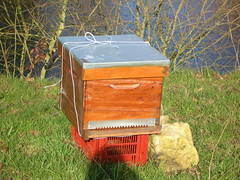
Curious, I took a look at the hives and sure enough the entrances were all frantically busy with bees rushing in and out; most exciting of all was that many of the bees were carrying pollen so there must be some food around somewhere.
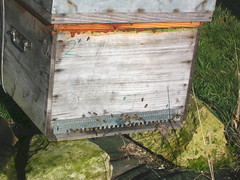
Now of course I didn't have my camera with me and by the time the dogs had walked what they considered a reasonable minimum distance and I'd got my camera from the house, it was already a degree cooler and the bees were on their way home. So the photo above shows activity but not the mass excitement of 40 minutes earlier.
It is still not warm enough to give the bees a liquid syrup feed but it is important to keep an eye on the weight of the hives (by hefting them) because this is the time of year when bees starve very quickly. We keep candy on top of the crown boards and it is still being taken down into the body of the hive. I hope that in a few weeks time it will be warm enough for us to open up the hives for their first spring inspection. For me, the first inspection is the beginning of spring and brings so much to look forward to. Of the six hives (including the wild hive) I am hopeful that four have colonies that will survive through to the spring; the other two are touch and go but I haven't given up!
But it wasn't only the bees who were actively showing signs of spring. More good news was to follow. On my way home I collected the eggs and was pleased that once again we had two - although hens lay less eggs during the winter, we have been worried during the past two weeks because we were getting one egg if we were lucky. When Max got home I told him I'd got the eggs and he was astonished - because he had collected two before he went out. And then there were two more this evening from our young hens who are obviously just beginning to come into lay.
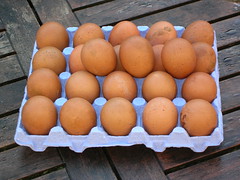
Looks like eggs are back on the menu!
This year's pigs - Berkshire Blacks again
You may recall that we first raised pigs two years ago and it was a great success. We were fortunate to have been recommended Berkshire Blacks - they were easy to look after, friendly and gentle and, ultimately, delicious.
Last year we wanted the same again but unfortunately the breeder lost her piglets during a dreadfully cold spell so instead we had a pair of Gloucester Old Spots x British Lop. They were much bigger and equally friendly - less gentle purely because of their size. However, we had tasted the best and although the meat from these two was excellent, it missed a certain je ne sais pas quoi.
So this year we were back searching for the Berkshires. First stop the original breeder but she has decided to retire from pig farming. She put me in touch with the couple who have bought her Berkshires and I was able to order three weaners. The great news is that this couple are as keen on Berkshires as we are and are hoping to keep them for years to come; and they only live about two hours away from us. Perfect!
So, without more ado I invite you to click on this link and see what Esme produced last week. Clever girl!

Last year we wanted the same again but unfortunately the breeder lost her piglets during a dreadfully cold spell so instead we had a pair of Gloucester Old Spots x British Lop. They were much bigger and equally friendly - less gentle purely because of their size. However, we had tasted the best and although the meat from these two was excellent, it missed a certain je ne sais pas quoi.
So this year we were back searching for the Berkshires. First stop the original breeder but she has decided to retire from pig farming. She put me in touch with the couple who have bought her Berkshires and I was able to order three weaners. The great news is that this couple are as keen on Berkshires as we are and are hoping to keep them for years to come; and they only live about two hours away from us. Perfect!
So, without more ado I invite you to click on this link and see what Esme produced last week. Clever girl!
Thursday, 25 February 2010
The Greenhouse
A few years ago a tornado came through our garden. It started down in Bordeaux and followed a path north. When I say "through our garden", you could actually see the path of damage that it left with untouched trees and fields on either side. Our neighbour's barn roof was found in our moat. We were lucky that the chimneys fell away from the house and not through the roof. It was an exciting night.
Not surprisingly, our greenhouse was damaged. Max managed to save most of the glass and we put clear plastic in the "glass beyond repair" areas. Unfortunately the clear plastic is now opaque and I made a policy decision to get it all sorted out. It will also give us an opportunity to clean the grime out from the glass overlaps - they really are disgusting and no doubt harbour all sorts of government health warnings.
This sort of thing seems to have a sort of dance routine. When I suggested that we sort out the glass Max immediately pointed out that finding glass that precise size would be impossible. The glass came with the frame.
Glass-cutting places?
S'pose so...but we'll never find the clips to hold the glass in. It all comes as a kit.
Er, greenhouse accessories?
Won't find them.
You get the idea. Anyway, if anyone else is thinking of changing or replacing greenhouse glass I can recommend Two Wests & Elliot for the clips. I ordered them over the phone and they arrived within the week. For your reference, they are called w clips and z clips.
Now for the fun of getting the glass cut!
Not surprisingly, our greenhouse was damaged. Max managed to save most of the glass and we put clear plastic in the "glass beyond repair" areas. Unfortunately the clear plastic is now opaque and I made a policy decision to get it all sorted out. It will also give us an opportunity to clean the grime out from the glass overlaps - they really are disgusting and no doubt harbour all sorts of government health warnings.
This sort of thing seems to have a sort of dance routine. When I suggested that we sort out the glass Max immediately pointed out that finding glass that precise size would be impossible. The glass came with the frame.
Glass-cutting places?
S'pose so...but we'll never find the clips to hold the glass in. It all comes as a kit.
Er, greenhouse accessories?
Won't find them.
You get the idea. Anyway, if anyone else is thinking of changing or replacing greenhouse glass I can recommend Two Wests & Elliot for the clips. I ordered them over the phone and they arrived within the week. For your reference, they are called w clips and z clips.
Now for the fun of getting the glass cut!
Tuesday, 16 February 2010
Honey update

I took advantage of the brief blast of sunshine last week to look at the hives and heft them - lifting the hive to see how heavy it is gives you an idea of how much honey is left inside for the bees. This time of year is critical as the bees are just beginning to enjoy slightly finer weather but there isn't any food for them so if the hive is low on stores they starve to death. I put a block of candy on the feeder boards of each hive and this hopefully sees them through to the appearance of the first food in the spring. The feeder board is placed between the main body of the hive and the lid and the candy sits on a hole so that the bees can get at it from underneath.
Of course the wild hive presents all sorts of problems. There is no feeder board with a convenient hole so the candy is placed pretty much amongst the bees. Needless to say getting it there upsets them (although I like to think they appreciate it when they realise what it is I've given them!) and they were getting just a touch irritated with me. I was only wearing the veil (not the trousers) because usually bees are quite sleepy at this time of year. Famous last words - there was nothing sleepy about these bees! Still, the job was done and hopefully the candy will help the bees through the rest of the winter.
Freezing potatoes, tomatoes and onions
Well, it's been a while. I went to London in September and when I got back I just lost the oomph for blogging. This was partly because there was just so much in the garden - 2009 was a mega year for fruit and vegetables. We ate most of the fruit as it came off the bush/tree, but the vegetables were so plentiful, preservation was required.
For once I didn't make any chutney. In our house this goes down as unforgiveable! I just never got around to it, partly I suppose because I actually had some work during the chutney making period so that took priority.
So, how to preserve vegetables? The great thing about the garden nowadays is that if you have a question you just tap it into a search engine and up comes the answer, or 110,000 of them, in an instant.

I have frozen potatoes successfully in the past, both as par-boiled (for roasting) and mashed (for re-heating and serving) and I did the same this year. However, I did store about 20 sacks (each containing 5-10 kilos) of potatoes in the barn and we are still eating these. Despite being stored in the cold and total dark, they have all started sprouting but not turning green. They still roast, boil and mash well so until they go green or rotten we'll eat those and keep the frozen potatoes for that period between none left and first earlies.

Tomatoes also freeze successfully and this year I just froze them whole. They are wonderful for pasta sauces - I just take them out of the freezer, run them under the tap (which makes their skins slip off easy as pie), chop them roughly and throw them in the pan. Easy.

Onions - well this was a new one on me. We had a fantastic crop of onions and shallots and as well as plaiting some I discovered that I could freeze onions - just chop them up and put them in a plastic bag. Use them straight from the freezer. I added a bag to the pasta sauce (and the faithful tomatoes) last night. It was excellent. However, remember that onions have a high water content so when they defreeze they are not quite the same consistency.
For once I didn't make any chutney. In our house this goes down as unforgiveable! I just never got around to it, partly I suppose because I actually had some work during the chutney making period so that took priority.
So, how to preserve vegetables? The great thing about the garden nowadays is that if you have a question you just tap it into a search engine and up comes the answer, or 110,000 of them, in an instant.

I have frozen potatoes successfully in the past, both as par-boiled (for roasting) and mashed (for re-heating and serving) and I did the same this year. However, I did store about 20 sacks (each containing 5-10 kilos) of potatoes in the barn and we are still eating these. Despite being stored in the cold and total dark, they have all started sprouting but not turning green. They still roast, boil and mash well so until they go green or rotten we'll eat those and keep the frozen potatoes for that period between none left and first earlies.

Tomatoes also freeze successfully and this year I just froze them whole. They are wonderful for pasta sauces - I just take them out of the freezer, run them under the tap (which makes their skins slip off easy as pie), chop them roughly and throw them in the pan. Easy.

Subscribe to:
Posts (Atom)

 Posts
Posts

