Friday, 29 July 2011

Noisette at work


Noisette has been a boon. Normally at this time of year Max performs dangerous acrobatics with a strimmer on the side of the moat. Noisette has changed this totally and as a result my heart beats at a much more regular pace.


We move her approximately every two or three days and this gives her a chance to cut everything within reach (boy, are we careful where we put her!) Now that the field at the back of the house has been cut we can put her at the top of the bank. Being a mountain goat she thinks nothing of the steepness of the bank and just makes her way down eating everything on the way. The brambles at the bottom are next I hope. The photos a bit dark so you can't seem them but they are thick and grow at the rate of knots!

Yes, she's earning her keep.

Thursday, 30 June 2011

Local lamb

We buy very little meat from the supermarket nowadays. We have our own pork, our own chickens (if the fox doesn't get there first) and each year we buy a lamb from our neighbour and have it butchered locally.

Martial raises his lamb on organic principles although as he's basically a small holder he doesn't bother with official tags; he just gets on with it. His herd of sheep have won prizes in the past at local agricultural fairs and he is rightly proud of them.


This year's lack of water has a trickle down effect (curious phrase under the circumstances as nothing is trickling at all around here). First of all one of Martial's wells has dried up and he is having to water his sheep and poultry from the town water which is expensive. Because his second well is almost dry he has cut right back on his vegetable growing - he doesn't want to have to spend money on watering those as well and will instead tuck into some of the surplus that he has conserved from previous years. The price of feed has rocketed sky high - when you can find it that is. He told us that most of the local farmers will get so little for their cereal products that they are cutting their losses by turning it into winter feed for the cattle. There is almost no straw since the wheat is so low and of course hay is scarce as well.

Although the cost of raising his sheep has more than doubled he has kept the price down to last year's level because if he doesn't sell them he'll have to carry on feeding them. This year we have bought two.

Martial is a small holder and very relieved he's not raising meat on a large scale farm. He came round last night to help us tag Noisette (the goat) and told us that at the end of the year he expects a number of farms to be out of business. The future does not look great.

So, if you can, buy your meat locally from a farmer. I realise this will come under the heading of luxury for many people so why not get together with some friends and share a 10kg pack? It will taste better and you will be helping your community's farmers.

Friday, 10 June 2011

The Fox

Living in the countryside has many sides to it, both good and bad. Personally I find the clean air and lack of town noise outways most of the bad. We grow a great deal of our own food, both fruit/vegetable and meat.

Max hunts with the local chasse and our freezer is supplemented with a few pheasant, rabbit, haunch of sanglier (wild boar) and chevreuil (deer), if we are lucky a hare. Only a certain number of pheasant, deer and hare are allowed to be shot each year and the hunt is issued with a "bracelet" for each animal in their quota. If you shoot an extra one, even by mistake (ie if you have one bracelet and two people each shoot a hare at the same time), there is a fine. (Yes, it is controlled.)

In return for his hunting invitations Max joins the local chasse for the occasional battu which are held throughout the year to keep down the foxes. Make no mistake about it, there are a lot of foxes, they are a nuisance and they do a great deal of harm. The battu are usually, but not always, requested by the farmers and the dates and areas concerned are posted at the Mairie.


This is the sight that greeted us when we went out to feed the chickens this morning. I make no apology for the photos although I have tried to keep them "long" shots. Believe me, close up they are not nice.

Our chickens are shut in at night. The fox dug his way into the pen and forced the door of the hut open. Several were left in the pen but we found two on the lawn outside; in addition, as we can't find them, he must have taken one adult and one baby back with him (or eaten it here I suppose).


Obviously I can't be sure, but we were told that this was probably done by a young fox. An older fox takes a bird back to the den. A young fox is learning the joy of killing and "plays" with his new skill until all the fun is lying on the ground around him.


Even the three chicks were taken.


In all we lost five chickens and three chicks. We have informed the head of the local chasse who will come and see us later today. The next battu is not for a few weeks but I for one will welcome them.

Tuesday, 17 May 2011

The fruits of our labours

It's that time of year. Everything is starting and from nothing at all we are suddenly bubbling over with things to bring into the kitchen. The asparagus, as always, started us off but we only cut the spears for six weeks so that the plants have a chance to regenerate for next year.

Then the early lettuce from the greenhouse which I planned to have ready for Easter - and amazingly it was!

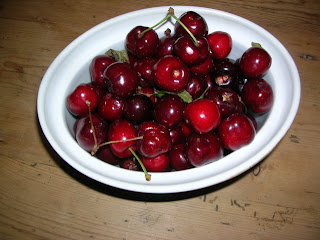
Now it's the turn of the cherries. We always know when they are ready because "les voleurs" arrive in ever increasing numbers. We don't mind too much - although we used to! A lot of the trees seem to have grown from pips dropped by the birds and these don't taste great. The really deep red cherries are only on a couple of trees and we grab these when we can. I'm not a supporter of fiddling with nature but if scientists insist on modifying genes and what have you, then perhaps they could sort out the genes in the birds so that they take the high cherries and leave the low ones for us. Now that would be really useful.

Although we eat most of what we pick, this year, if we pick enough, we'll put some in jars and sterilise them so that we can enjoy them later in the year.

And of course it's strawberry time as well. We picked these this evening:


There's nearly two kilos there and we've picking the same amount every two days for the past week. I don't make jam as we don't eat it in large enough quantities to make it worthwhile. However, even I can't eat this amount of strawberries - well, not really and not without really bad consequences! - so I've started making a strawberry coulis which I freeze in plastic cups.

I've discovered the most amazing Delia Smith recipe for strawberry cheesecake ice cream however I prefer to make it plain and use the coulis to pour over afterwards. It really is delicious! If you want to try it you'll find it in the Summer Collection - it involves roasted digestive biscuits and hazelnuts...are you sure you can resist?!

Tuesday, 10 May 2011

The swarm in the hive - part two


We got back to our neighbours to sort out the colonies in the abandoned hives this afternoon. There were two and both had built comb all over the place.

The first one we opened turned out to be without any queen and no brood whatsoever. We had already tied most of the wax into frames (lots of honey in them too) so we put them into a nuc and closed them up.

The second hive was a different kettle of fish. The main box was sitting without a floor on a tyre - see above. We knew that there was a stack of wax built onto the roof and that another pile of wax was lying in the tyre. We opened it up carefully.


With our hearts in our mouths we carefully turned the lid upside down. So many bees and we still didn't know if the queen was in the lid or in the tyre - or not there at all perhaps. Very gradually we removed plaques with honey and put them to one side and concentrated on the plaques with brood - this is when we knew there was a queen present so long as we hadn't already killed her. This is all fresh comb and there was a reasonable amount of brood - about four plaques - so we reckoned the queen was probably up here somewhere and not down in the tyre. Tying wax - which is heavy when it has brood and honey in it - into frames is not easy. We did our best and I just hope we improve with experience.

The reward was great. Having put four frames of brood into a nuc I suddenly saw the queen still on the lid. We managed to catch her and having put her to one side we had a moment of reflexion on what to do. There were so many bees!

We finally decided to put the colony back into a big hive. We didn't have one with us so we had to make do with the various elements around us. Brood box, crown board and roof were no problem. The floor we found was rotten and fell apart so we made do with another roof. We then put the frames of brood into this box and surrounded it with frames of honey which I had bought up with me.


The discussion and finding the bits and pieces took approximately five minutes. During this time the bees had found the queen in the cage and were gathering around her. It's amazing how nature works so efficiently! In the picture above you can just about see the cage - look at the breeze block in the middle; the cage is under the pile of bees on top, at the front on the right. (OK, you have to know exactly where it is to see it!)


We put this DIY'ed hive just behind the original placement and once the frames were organised we dropped the queen in over a frame of brood. The picture above was taken less than five minutes later. The bees have found her majesty and have started signalling to the other bees who are now marching out of the tyre and into the hive. This has to be the best part of hiving a swarm - or colony in this case.

My only regret with the whole exercise was not marking the queen. It doesn't matter. We know she's in there and next week we'll take another look to see how things are going.

In the meantime there is the orphaned colony to deal with. More thought is required but I suspect that we will go back tomorrow and unite the two. I would be happier if the colony with the queen had more bees to forage and bring in food.


This final picture is the rest of the comb that we couldn't save or fit into frames. Despite being able to support a huge weight of honey or brood - not to mention bees climbing all over it - comb is incredibly fragile once you start trying to manipulate it and breaks easily. The bees are all over it because there is so much honey in there. We will work out tomorrow how to save the honey. I rather suspect that we won't regret it!

Our work was further rewarded when we drove back down through the wood and past our neighbour's house. He was waiting for us and he and his wife called us in for an apero. This is not to be underestimated. Firstly the glasses are HUGE. Secondly it was fizzy. Thirdly having finished more than I normally consume in a week my glass was refilled.

Forgive me if I leave you now - hic...hic!

Wednesday, 4 May 2011

More Muscovy


Mason came out today with her twelve babies. Since the one we hatched was named Brian (born on Easter weekend) the ducklings have been awarded the title of the 12 Apostles. It's all the fault of Monty Python mad children.

They are very sweet and fluffy. It's slightly alarming that she has chosen to sleep on the bank tonight. Hopefully if the fox comes (he last visited three weeks ago and took a chicken) she can just tumble them all down the hill and into the moat.

Tomorrow, if the weather holds, I'll inspect the hives and try and sort out the two in our neighbour's garden.

Tuesday, 3 May 2011

New Life Up the Garden Path


Our Muscovy (Mrs Mason and her husband is Mr Fortnum) has been sitting for ages. Finally today we saw her babies. The larger one in the front is Brian - born one week ago in the incubator. Mrs Mason has taken him (her?) in without a murmur.
The chicken came out yesterday with her four golden chicks. Gorgeous.